Thursday, January 30, 2020

Bad at prayer


At a staff meeting recently, we were having a conversation about prayer. The overall outcome of it was that none of us felt we were very good at it. But, to reduce the conversation to that blanket outcome is to do it an injustice.

I love a good tuna sandwich.

I know that came out of nowhere, but stick with me.

The first time I ever visited the McMenamins on Broadway near Lloyds Center in Portland I ordered their tuna sandwich. It was the best tuna sandwich I had ever eaten. Still is, in fact. Now every time I visit a sandwich shop for the first time, I’ll try their tuna sandwich. Not just because I love tuna sandwiches, but because I’m trying to find another unforgettable tuna sandwich. I’ve even tried to duplicate that sandwich at home. A little dill, a little curry powder, a little celery, a little onion…I’ve come close, but it isn’t quite the same. I’ve even gone back to that McMenamins, but it has never been quite the same.

Good conversations are like that with me. When I’ve been in a conversation that has affected me, I tend to roll it over in my mind and analyze it. What made that conversation stand out? Why did it seem more profound than other good, meaningful conversations I’ve had? What is that secret ingredient that I can’t quite figure out?
Sometimes it is simply that those conversations come at the right time.

Once on a summer bicycle tour from the Canadian border to Government Camp, I spent the night in Winthrop, WA. When we rolled into town it was close to 9pm. The day had started about 7 that morning, and by the time we arrived we had ridden about 75 miles which included climbing 3 mountain passes. Lunch had been shortly after noon, and our bodies had been working on empty for a couple of hours—we were starved. There was one cafĂ© still open in town and there wasn’t even a discussion. Unanimously and spontaneously we decided to eat there rather than wait to fix our freeze dried meals after we pitched camp.

I ordered a chili burger. It was the best chili burger I’ve ever eaten. Granted, it may well have been a burger patty warmed over from the lunch rush covered with a generic can of chili, but I remember it as the best chili burger I’ve ever eaten. Part of me wants to go back to that place in Winthrop and order another chili burger to see if it really was that good; another part of me wants to leave the memory enshrined as it is. Chances are it seemed so memorable because it was exactly what I needed at the time.
Honest, this post really is about prayer and conversation, not food. It is just that those three seem to be perfect metaphors for each other.

Anyway, this conversation at our staff meeting was so profound to me because it came just when I needed it.

With all that is going on in our Church body lately—Marta resigning, the budget struggles, the ongoing wrestling with the debate about human sexuality, I often have trouble sleeping through the night. I’ve always awakened once or twice every night, but I’ve also always been able to go right back to sleep. Now when I awaken it seems my mind wants to immediately sprint down one of these trails and keep running until I finally give up and go sit in the living room and read for a while.

The night before our staff meeting, I awakened at 3am. My mind began running as usual. It couldn’t decide what trail it wanted to take, so it ran down one after another until it was time to get up. I had no ability to control or fix any of the things I was fretting about, especially at 3 in the morning, but even telling myself that didn’t help. It has in the past.

Then we had our staff meeting conversation.

That night I pleaded with God for a full night’s sleep. At 1:45 am, my eyes popped open and my mind started revving up for its nightly run. In desperation I mentally reached into the box of tools I had acquired during my training in spiritual formation and I pulled out the Jesus Prayer. If you’re not familiar with the Jesus Prayer it is just what the name implies. No one quite knows where it came from; it probably started with one of the Desert fathers or mothers. It consists of the simple phrase, “Lord Jesus Christ, Son of God, have mercy on me.” That’s it.

I began repeating that prayer over and over in my mind—the next thing I knew it was 6 o’clock and time to wake up.

I guess one could easily argue that the Jesus Prayer functioned much like counting sheep. I focused my mind on something and then droned it to sleep.

But the Jesus Prayer helped me do far more than that. By praying the Jesus Prayer I was acknowledging that I needed to pray, and recognizing who I needed to pray to. At the same time it helped me admit that I didn’t know what to pray about or what to ask for even if I did know what to pray about.

Praying the Jesus Prayer helped me to grab ahold of what Paul was talking about when he said, “In the same way the Spirit also helps our weakness; for we do not know how to pray as we should, but the Spirit Himself intercedes for us with groanings too deep for words”(Romans 8:26-27).

I grew up in a tradition that believed a prayer wasn’t valid unless you made up the words yourself. But when I think about it, when Jesus’ disciples asked him to teach them to pray, he taught them a rote prayer. I know, I’ve been through the workshops that teach the Lords prayer as a model—our prayers should contain the same components as the Lord’s prayer, ie. adoration, confession, etc. All that may be true, but I think it misses an important point, a point Paul makes in the verse above.

When the disciples asked to be taught to pray, Jesus gave them words. I realize now Jesus understood that prayer is one of the rare things in life we do best when we are the worst at it. Our best prayers are often those we can’t wrap our minds around—those that we cannot put into words. So, Jesus gave us words. Those words may not be the exact words to express what we feel or want, but they are words that we can groan out so the Spirit can say what our hearts can’t.

I think that is the beauty of the Jesus Prayer. The prayer simply asks Jesus for mercy. Asking for mercy is a broad request, and most often that is exactly the right prayer. We need mercy because we don’t understand. We need mercy because we don’t know what to say. We need mercy because we don’t know what to ask for and if we did ask for something it would probably be the wrong thing. So, we ask for mercy and the Spirit fills in the blanks.

Please understand me, I’m not saying we should never pray in our own words. Sometimes a heart to heart with God in our own stumbling words is exactly the thing that is needed. What I am saying is that there will be times when our own eloquence fails us, but the Holy Spirit’s eloquence never will. That’s a promise.

So, the next time you feel like a failure at prayer, thank God for that. Then grab the Lord’s Prayer, the Jesus Prayer, or a Psalm and pray away. Nothing will get lost in the translation.

Tuesday, June 25, 2019

Mentors


It is to be expected at my age, but over the last couple of years I have lost three men who have been instrumental in shaping and influencing me. Looking back on our relationships, I would consider them mentors. The relationship didn’t feel like that at the time, but looking back I can see that is precisely what it was. They were shaping me, but none of us had that intention when we entered and continued the friendships. They were just that, friends. The mentoring happened because of who they were, and perhaps also because of what I needed at the time.

Although these three men were very different, they shared a couple of characteristics. First, they all taught me, mentored me, shaped me, and even by example corrected me, while being cleverly disguised as my parishioners. I thought all along that I was pastoring them, when just the opposite was true.

The other characteristic they shared was that they were good men, and I think that at their core that was what each one of them aspired to be.
The first one to go was Dale Hair. Dale was an old cowboy from Oklahoma. He was tough, and scarred. His hands were gnarled from years of working with rope, leather and wire. He came from the old school where you showed up for work even when you were hurt, sick or there was 6 feet of snow on the ground. When he needed sleep a bed was fine if one was available, but a sleeping bag on the ground, or a saddle blanket on the floor of a horse trailer worked just as well.

Dale had worked with his hands, and lived on a laborers wages for a good portion of his life. He was a master of making due with what he had. He had a genius for fixing things with duct tape and bailing wire. But that’s not what I learned from Dale—or maybe it was.

The gift Dale gave to me was showing me how a man can learn to live with his faults—another form of making due with what you have. Dale had a few faults. That’s not my critique, that is Dale’s honest assessment of himself. He struggled with alcoholism, he occasionally spoke without thinking about what he was saying, and he was known to commit himself to things without fully considering the ramifications to himself and his family. Every once in a while Dale would grab onto an idea and stubbornly cling to it long after common sense had shown it to be fruitless or misdirected.

Dale wasn’t proud of his faults, nor did he use them as an excuse. He just owned them. He never let them stop him from being a good man. In fact, he used some of those very characteristics as tools to be a good man.

Dale loved his friends openly. The same impulsiveness that often led him to speak without thinking also allowed him to care without judging. He was kind, and his rough exterior merely added to the texture of his kindness.  Many people are generous, but Dale would even give you something he needed himself if he thought you needed it more.

The same stubbornness that tempted him to hold onto ideas beyond their useful life also made him tenaciously loyal to his friends even when they disappointed him or hurt him. I know that is true because I was on the receiving end of that tenacious loyalty more than once.

Dale taught me several things about wisdom. First, he taught me that our individual characteristics—the makeup of our personality and nature of our tendencies and thought processes—do not automatically lend themselves to faults or strengths. The same characteristics that make us susceptible to our worst faults can also be the foundations for our greatest strengths. It all depends on where we point them.

The second thing Dale taught me about wisdom is its tidal nature. It ebbs and flows. I used to think of a wise person as one who has gained enough from their own experience to speak into another person’s life. What I saw in Dale was the other side of wisdom. He had learned enough from his own experience to allow others to speak into his life. Dale knew his own pitfalls, and he listened to his friends when one would warn him that he was wandering too close to a ledge. He understood that those who love us can often see us more clearly than we can see ourselves.

Dale was a good man.

The second to go was Witt Hawkins. Witt lived in Chicago and worked for the Ford Motor Company for his entire life up to retirement. When he retired, he and his wife Pam moved to a town in the mountains of California that was too small to have a stoplight.

I never met anyone more comfortable in his skin than Witt. Witt learned something that most people never quite figure out; He learned to know himself, and he payed attention to what he learned. Witt knew how to say no.

Don’t get me wrong. Witt was not obnoxious about saying no; he was always a gracious gentleman. But he knew himself and knew what he was willing and able to commit to. He said yes to those things and had no regrets about saying no to everything else. Unlike Dale, who might commit to something without thinking, I knew that Witt thoughtfully and prayerfully considered every request made of him. I was never offended or hurt when he said no—and he said no to me often—because I knew there was a good reason he said no. He never seemed to feel compelled to explain his reasons, but something about him reassured me that there was one.

When Witt said yes, I knew he was all-in and committed. His yes was as final as his no. As I said, he worked for Ford Motor Company all his life and he never drove anything but Fords. He was the same with his friends. When Witt said yes to a friendship he was making a lifelong commitment. Even a dozen years after we moved away from Mariposa, he still religiously sent me birthday and Father’s Day greetings every year. The relationship didn’t end just because we were hundreds of miles apart, it just had to be lived out differently.

I think Witt was trying his best to live out his picture of God. I never heard anyone pray like Witt prayed. His prayers were melodic, rhythmic, poetic and powerful. But he didn’t pray just to sound good, he believed what he prayed, and in the One to whom he prayed. He was confident that when he asked something of God, that request was not taken lightly. He believed God’s yeses and noes were honest and carefully weighed. He never asked God for a reason for saying yes or no, but he believed there always was a good one and he trusted that.

Witt was a good man.

The latest friend to go was Ken Austin. Ken was/is an institution around here, but I didn’t know that when we first met. He was just a fascinating, brilliant old guy that started coming to our church with whom I felt an instant connection. It wasn’t until I saw his book, American Dreamers sitting by the register at Jac’s drive-in, and then had a couple of members of the church explain to me who he was, that I finally put 2 and 2 together.

In spite of all his success, Ken was keenly aware of the missteps and mistakes he made along life’s journey. He was not afraid to mention them or point to them. He didn’t do so with aching regret as if they were permanent blemishes on his life, rather he spoke of them as if they were moments of grace where God and the people around him, or perhaps God through the people around him, lifted him up and carried him through.

Ken was obviously conscious of the success he had in his life, but he never claimed much credit for it.  His wasn’t a false modesty. He acknowledged that he had been gifted with a genius for engineering and invention (he always spoke of it as just that—a gift), but he was quick to point out that without Joan’s encouragement and business sense, and contributions by others who encouraged him or challenged him along the way, his genius might well have produced nothing.

Ken and I tried to have coffee every couple of weeks. We would just sit and talk about stuff. I would show him photos of projects I was working on, and he would show me things he had done, was doing, or wanted to do. We were just two guys talking about things that brought them joy.

It was only a couple years ago that I met Ken, so I only knew him for the last years of his life. I’m sure with all the success he experienced in his life, and the stature he had in this community because of his generosity, there was great pressure on him to be a certain person, or to project a particular image. But the man I knew was not affected by that. He was content with just being Ken, and his desire to honestly be himself invited me to honestly be myself. Ken became a safe and comfortable place for me.

Ken taught me that it is important to pay attention to your life because God is always using people to distribute grace into it. If you don’t pay attention, you might miss it and that would be the greatest tragedy. No matter where one is in life there is much to be grateful for. Misery is not an outcome of bad times so much as a lack of gratitude. The entire time I knew Ken he was aware that because of a respiratory illness his life was coming to a close. That knowledge never dampened his gratitude.

Ken also taught me that no matter where a person is in life, whether successful, famous or homeless there is an authentic, human person wanting to be known and seen. Deep down inside we are just guys wanting to talk about things that bring us joy. One of the last times I saw him he was supposed to be unresponsive, yet when he heard my voice he acknowledged me and greeted me by name. I will always remember that and look back on it with great joy.

The last text I sent him was some pictures of an old hand plane he had given me. I had restored it and sharpened it. The photos showed that great old tool making beautiful wood shavings like it was designed to. Perhaps that is a fitting picture of Ken. He might well have seen himself as that great old tool that had been redeemed time and time again so he could do the very thing he was created to do.

Ken was a good man.

I miss them all so much.

Wednesday, April 3, 2019

Twinkle


Twinkle, twinkle, little star,
How I wonder what you are.
Up above the world so high,
Like a diamond in the sky
Twinkle, twinkle little star,
How I wonder what you are.

At any given moment, our sun is releasing 386,000,000,000,000,000,000,000,000 watts of energy created through the process of nuclear fusion. That fusioning process converts about 600 billion tons of hydrogen to helium every second, resulting in about 400 million tons of matter being converted to energy every second. The core temperature of the sun, where fusion occurs, can reach 27 million degrees Fahrenheit.

As we know, the sun is a star. In fact, though it looks much larger to us, it is just an average sized star. There are many stars in our own galaxy that are significantly larger than our sun. For example, Mu Cephi is 1500 times larger than our sun, Betelguise is 900 time larger than our sun, and Antares is over 500 times larger. That means you can multiply the numbers above that represent the activity of our sun by perhaps hundreds of times to approximate what is happening on other stars.

Doesn’t it seem ludicrous that we describe what stars do as “twinkling”?

I get that the song above is a children’s song. I get that when humanity first noticed the stars, they had no way of knowing that massive nuclear fusion was behind the pearls of light they saw in the sky. But we know that now, and we still refer to what stars do as twinkling.

We’re used to stars that twinkle; we’re comfortable with stars that twinkle. We think stars that twinkle are attractive and make for a nice decoration in our firmament.

I suspect that the language that we use to describe God is similar to using the word twinkle to describe a star. Karl Barth, the Swiss pastor and thinker once said, “The word became flesh, and through theologians it became words again.” I think when we try to describe who God is, and what God does, we risk just that. When we talk about God’s nature, God’s presence, or even God’s love, we’re really describing God’s twinkling and don’t begin to capture the unimaginable heat and light that is behind it.

For the most part, we are okay with that. We’re used to a God who twinkles; we’re comfortable with a God who twinkles. We think a God who twinkles is attractive and makes for a nice decoration in our firmament.

Many people have asked me why I’m going to Kenya in May. There are a lot of practical, ministry related reasons, and they all are part of that decision. But if I dig way down inside, I feel like I have become comfortable with God twinkling in my firmament. I’ve been aware of that for some time, and I feel like it is eroding a void in my Spirit.

There have been times in my life when I have managed to get a glimpse beyond the twinkling. It has always changed me. I’ve also noticed that it has happened when I was in unfamiliar territory in situations beyond my control, tools and resources.

Perhaps that is why people go on pilgrimages. When we purposely put ourselves in situations beyond the realm of our own comfort and power, our spiritual senses sharpen, and we can feel the heat and see the brilliance of a God that before had merely appeared to twinkle.

One famous Christian pilgrimage is called the El Camino de Santiago de Compostela. Compostela is a derivative of the Latin term that means “field of stars.” I used to think that referred to the beauty of the stars one experiences when out in the countryside away from city lights. Now I can’t help but wonder if the name came about because sometimes pilgrims on the trail are consumed by a fusioning God who previously only twinkled in their firmament. I hope so.

So, I’m going to Kenya and I hope to learn a lot, and experience a lot, and serve a lot. But most of all, I hope to come back with squinting eyes and smelling a little bit scorched.

Tuesday, March 19, 2019

Composting Wisdom


I constructed my first hugelkulture this past weekend.

That probably doesn’t mean much to most people, but it felt like an accomplishment to me.

Hugelkulture is a German term that means “hill culture.” It is a gardening technique that mimics what happens on a forest floor. In the forest, a tree will fall and over the years begin to decay. Storms come along and knock branches off of other trees and they pile up on the logs. Also over the years branches, twigs, leaves and needles will add to the pile. Rain comes and washes soil up onto the pile and after a while there is new plant life growing on a decaying pile of debris—and that pile of decaying debris will nourish that new growth for decades.

We had a few logs around the place that were beginning to decay. I dug a shallow pit and rolled the logs into it. Then I gathered up some good sized limbs and piled them on top. After that I added a layer of branches and twigs, a layer of leaves, a layer of compost, and then I shoved the top soil from the pit back on top of the mound. The final layer was another coating of compost. It looks like this:


Sunday during the discussion time in our service, Curt asked, “How do we develop wisdom.”  Believe it or not, the hugelkulture helps me think through that question.

Proverbs 3:13 says, “Blessed are those who find wisdom, those who gain understanding.” And Job 12:12 observes, “Is not wisdom found among the aged? Does not long life bring understanding?” Verses like these imply wisdom comes with age and experience, but I don’t think that it is automatic. Many of us probably know people who have a whole sack full of experience but never seem to learn a thing from them. I suspect if we’re honest most of us have experiences we seem to repeat because we don’t extract the wisdom they offer to teach us; I know I do.

When you build a hugelkulture there are certain woods that should be avoided. Cedar and redwood don’t work well in a hugelkulture. They take forever to decay—that’s why we make fences, decks and outdoor furniture out of them. If you’re building a hugelkulture so you can use the decaying wood to fertilize the garden you plant on it, choosing a wood that resists that very process is counterproductive.

In thinking through the process of gaining wisdom, cedar and redwood represent to me those experiences that we hold on to--that just won’t seem to go away. For whatever reason, maybe they are too painful, or too embarrassing, or too …, so we don’t let them go. We don’t break them down so we can extract the nutrients of wisdom out of them. This keeps us from using them to nourish and sustain our next generation of experiences, relationships and decisions.

Another species of wood to avoid is Black Walnut. It decays and breaks down just fine, but there are oils and resins released in that process that can actually be toxic to many young flower and vegetable plants.

This represents those experiences that we have “gotten over.”  We may be able to think about them, and talk about them, and maybe even laugh about them without flinching. We can break them down just fine, but there is some residue from them that might make us averse to risk, or unable to trust members of the opposite sex, authority figures or family members. They may adversely affect how we see ourselves or other people.

When I was 7 years old I was a fairly chubby kid. I remember my Dad once making a joke about my weight to a group of men. It got quite a laugh. I’ve broken it down and let it decay.  I can talk about it. I can even say that I’ve forgiven my Dad and it didn’t affect our relationship. I even learned a lot about how to respect my own kids and grandkids. But I can tell you this, feel free to invite me to a pool party, I’ll come, but don’t expect me to swim. After 45 years the residue of that experience still shapes the way I perceive my physical appearance—it’s still a log in my hugelkulture.

Is that wisdom? No. I suspect I have missed out on a lot of fun and friendship over the last 4 ½ decades. I guess I could blame my father, but that wouldn’t be honest. That one incident is not at all representative of the entire scope of his fatherhood. The tragedy of that story is that I never was able to get past the residue of that experience and it stunted the growth of some of the seedlings that came after it.

I think the final lesson about wisdom from my hugelkulture is that ultimately a hugelkulture is a big pile of humus. It just so happens that humus is exactly what plants need to grow. It is significant to me that our word humility comes from the same root as the word humus. I think humility is to wisdom what humus is to plants. It takes humility for wisdom to grow.

It takes humility to learn from our experiences because to learn we have to face ourselves and admit we have something to learn. It takes humility to break down our experiences and extract the nourishment from them. It takes humility to admit that sometimes we can’t figure out how to extract that nourishment by ourselves, and then it takes humility to pick up the tools of counseling, spiritual direction or deep conversations with trusted friends to help us dig out the wisdom.

Our faith is focused on a God who identifies with the common—we worship a God who was born in a stable, died on a tree, rose from a cave and still wears a body marked with scars. It is only fitting that such a God would use the compost of everyday experience and basic humility to teach us wisdom.

So I guess obtaining wisdom comes down to a choice. Do we allow our experiences to merely be an unsightly brush pile or do we build a hugelkulture? It seems to me the only difference between the two is a little intentionality, a little humus and a little sweat.

Bruce

Thursday, December 7, 2017

The Light
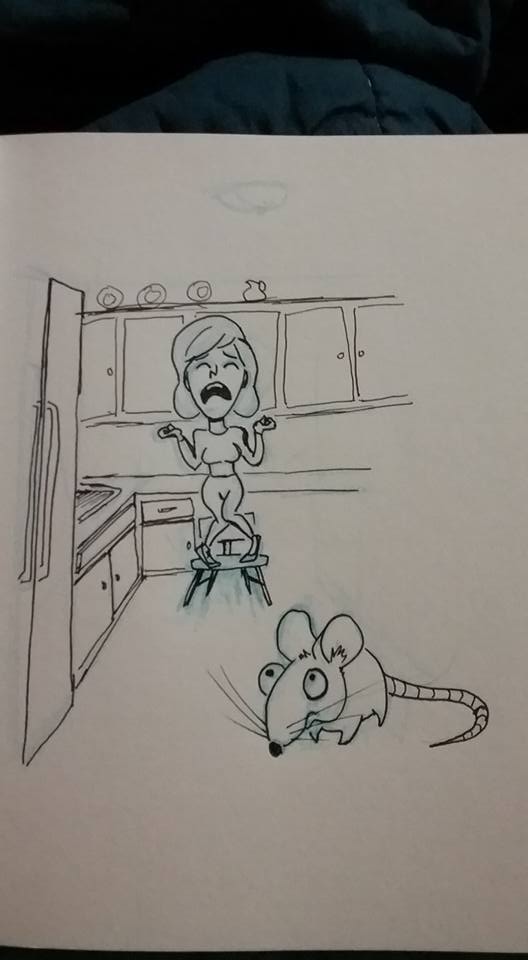
I am terrified of mice in the house. I mean pee your pants, stand on the kitchen table and scream terrified.  Yep, that’s me in my husband’s illustration of the word fear.
So it’s 2:30 on a dark cold December morning  and I am laying quietly in my bed trying to go back to sleep after putting my 5 year old to sleep in our bed. I am rudely and suddenly awoken by a high pitched squeaking. It sounds close and stuck! My heart starts racing. I sweat through my clothes and it starts to drip down my face. Now we recently got a hamster so my first irrational thought is maybe the hamster escaped through it’s locked cage and made it through our shut door without me noticing. Hmm..that seems plausible. No, it’s got be a mouse. At this point the noise is louder and sounds like two mice fighting.  One thing  important for you to know is that I drink carbonated water. My rational brain clicks on for half a second and says, “Maybe it’s your water.” No gosh dang it rational brain, that is two mice fighting it out in my bedroom. I am now terrified enough that I am willing to ask for help despite the possible consequence. “Isaac, Isaac,” I shout in a loud whisper in order to try and not wake up the five year I just got to sleep.  Finally I awaken my “could sleep through a zombie attack” husband. “Do you hear that.” “Yeah!” “What is it” I screech out. “I don’t know”  he mumbles. Then summoning all of my courage I ask, “Should I turn on the light,” which I can reach without getting on to the floor. I decide to risk it. Blink, the light comes on. Guess what is not there? That’s right two sword fighting mice. What is there is my water tipped over noisily leaking let bits of water and air.


As I turn out the light and take slow deep breaths to calm myself I hear the small sweet voice of the Holy Spirit. “It was only the very thing you need to live, water, and all you had to do was look at it in the light. Everything seems dangerous in the dark. Let me shine a light on those noises, events, and sights that have your heart racing. Let me show you what they really are. You will have hope, peace, and love in my light.”


The people who walked in darkness have seen a great light. -Isaiah 9:2


May the God of hope fill you with all joy and peace as you trust in him, so that you may overflow with hope by the power of the Holy Spirit.- Romans 15:13


Ask yourself today, “What is God asking me to bring into the light?” by Janelle

Tuesday, February 28, 2017

The Mirror-Living in Community

Kids are often great mirrors. The type of mirror that magnifies every nook and crannie on one's face. The mirror the highlights the flaws that you didn’t see before.


This week at kids fun night I had one of those God inspired, kid driven mirror experiences. It just so happens that the theme for kids fun night this year is community. During the 3rd, 4th and 5th grade night the kids were giving a game to play. It was simple, count as high as you can as a group. The only rule was  only one person can talk at a time and if two or more people talked at one time the counting started all over. As one can imagine the kids started shouting out numbers like popcorn  bursting out of hot oil. At some point two louder voices started counting on their own until a third loud party interrupted and we had to start again. At this point there was a suggestion that we go in a circle. That we each say our number after the person next to us. There was consensus that this plan would work and was the most likely to get us counting higher.


They started out 1, 2, 3,  and then a pause. One little girl needed a second to think through what she was suppose to do. But impatiently another child further down the circle shouts 4 at the same time. We have to start again. A collective “ugh” is heard. Tears burst out of the little girl who was skipped over and the other child claims, “What there was no one talking.” The teacher ask what should we do if there is a pause from one person in our community, someone who needs a second to think. A child shouts, “Kick them out!” My heart sank at the reality of this answer.  “No, no, no,” other children cry “We’ll wait.” The teacher affirms that we should wait for the person. Pointing out when we don’t  wait we hurt others causing damage to the person and the community. At this point the little girl was still very teary and had stepped out of the circle, out of the community, and wasn’t able to rejoin. How often does our impatience, need for comfort, desire to complete a task or difference in understanding get in the way of supporting and loving one another.  It was decided to start again. 1, 2, 3, 4,5...34. We made it around the circle each person doing their part to listen, speak when they were suppose to and we were kind to those next to us, but without a beautiful part of our community.


This for me so clearly illustrates  how we should be living in community. When someone disagrees with us or needs a moment to think, do we by pass them? Do we kick them out for not acting fast enough? Do  we watch as people tearfully remove themselves from community because they were not heard?  I would urge us to wait patiently, to listen and speak carefully, to be kind and generous. To do our part and stay in the circle.

Hebrews 10:25 And let us not neglect our meeting together, as some people do, but encourage one another, especially now that the day of his return is drawing near.

John 13:34-35  34 “A new command I give you: Love one another. As I have loved you, so you must love one another. 35 By this everyone will know that you are my disciples, if you love one another.”

Wednesday, February 8, 2017

Moving Through the Mourning


We've stepped into this time of mourning over the decision to split made by NWYM. We may even recognize that mourning is necessary to properly heal and move on from a devastating loss. We might even acknowledge that if we don’t allow ourselves to mourn, and give mourning space and time for it to do its healing work, our grief may color any decision we make going forward in ways that we might ultimately regret.
But even if all of that is true, and we agree to give ourselves time to mourn before we try to discern next steps, that doesn’t answer the burning question. "How do we mourn?"(I know some of you probably don’t see that as the burning question. You would lean toward "how do we respond to this?" That may actually be an indicator of the way you are wired to mourn—more on that later."
Dr.s Kenneth Doka and Terry Martin have identified two prominent categories of mourning. As it is in most cases, categories in real life are never nearly as clean as categories in academic theory. It might be more helpful to think of these as two ends of a spectrum with a particular individual's method of mourning falling anywhere along this spectrum.
  • Instrumental Mourner—Instrumental mourners tend to process their grief mentally and physically rather than emotionally. In the case of a death in a family, the instrumental mourner would be the one who jumps in to make funeral arrangements and handles all those little details that others find overwhelming. In the case of a terrible tragedy an instrumental mourner might join a group like M.A.D.D., or campaign for a stop sign at the intersection where a fatal accident occurred.

In our situation an instrumental mourner might mourn by analyzing how yearly meeting arrived at the decision it did, or how it might have been handled differently, how we might avoid the same mistake. Or how we should approach a decision making process ourselves.
  • Intuitive Mourner—Intuitive mourners tend to process their grief emotionally. They tend to be more comfortable with their emotions and are more sensitive to how they feel and others feel. In the context of a death or tragedy, intuitive mourners are the ones who weep openly and talk candidly about their feelings. To others they may appear to be devastated by the loss.

Along with these two ends of the mourning spectrum, another type of mourning has been identified.
  • Dissonant Mourner—Dissonant Mourners tend to hide their feelings to protect whatever public image they want to project. This may be a person who strongly feels the need to vent his/her emotions because nobody else seems so deeply affected. It might also be someone who feels a sense of relief after the death of loved one after a long and agonizing illness. He or she might feel guilty about not being grieved enough.

Dissonant mourners can show up anywhere on the mourning spectrum.
So, if each individual mourns differently, how do we help each other through the mourning process?
  • Give each other grace—Remember, everyone mourns differently. It is not uncommon for intuitive mourners to see instrumental mourners as unfeeling or hard hearted. It is also not uncommon for instrumental mourners to see intuitive mourners as weak. Let it be okay that others mourn differently than you do.
  • Give yourself grace—Let it be okay that you mourn differently than others.
  • Tell stories—Storytelling seems to be one activity that is healing no matter how one mourns. It appeals to the instrumental mourners need to analyze and reflect, while giving intuitive mourners a way to feel and express.

When my family gathered to view my Dad's body before his funeral, we were ushered into a small room to wait while the funeral director set up the casket for viewing. I was leaning against the wall looking out the window. I was caught up in my own thoughts as was everyone else. I happened to reach into my pocket and when I did I felt my pocket knife. The feel of that pocket knife in my hand brought back a flood of memories of my Dad saying things like, “every man should carry a pocket knife. You never know when it will come in handy." And later when I worked for him, him asking me, "where is your pocket knife?" Or saying, "if you had your pocket knife with you, you could fix that problem."
I pulled my knife out of my pocket and held it in my open hand looking at it. This caught my brother's eye. An almost imperceptible smile crossed his face as he reached into his pocket and retrieved a small pocket knife. One of my brothers-in-law whose first job had been working for my dad, pulled out a pocket knife as well. This initiated a time of story telling that allowed us to share our mourning together.
I invite you to share your stories and memories, pleasant or hard, of camp, retreats, summer yearly meeting, shared events with other churches—anything that connects to NWYM—as a way to share our mourning together.

Grief is a part of being human, and mourning is a God-given way to express that grief and share our humanness. Psalm 34:18 promises, "The Lord is near to the brokenhearted And saves those who are crushed in spirit."  I pray that we not only allow mourning to do its healing in us, but also help us to allow space for God to be present with us.